Which Telescope Is Good For Mounting Camera?
Choosing a telescope for mounting a camera—either for astrophotography or terrestrial photography—can be tricky, especially for beginners or intermediate enthusiasts. To ensure you make an informed decision, I will provide practical guidance, technical considerations, and insights on what makes a good telescope for camera mounting, and highlight popular choices.
Astrophotography (or simply photographing celestial objects) requires specialized equipment to achieve quality results, but the good news is that advancements in technology have made this hobby increasingly accessible. Below, let’s dive into what telescopes work best for mounting cameras and how to select one based on your needs.
Understanding the Telescope-Camera Relationship
Before diving into specific telescopes, it’s essential to understand how telescopes and cameras interact. The telescope serves as a high-precision optical system, effectively acting as a long telephoto lens for your camera. Because the demands for astrophotography are often greater than for casual stargazing, the following factors become critical:
1. Optical Design: Different types of telescope optics (e.g., refractor, reflector, or catadioptric) greatly influence image quality.
2. Aperture Size: This determines the telescope's light-gathering ability, which is crucial for capturing faint celestial objects.
3. Mount Stability: The mount should be sturdy enough to prevent any vibration or movement during long exposure shots.
4. Tracking Capabilities: If you plan to photograph deep-sky objects like galaxies or nebulae, the telescope’s ability to track celestial motion relative to Earth is vital.
5. Compatibility: The telescope needs to be easily adaptable to your camera, whether it’s a DSLR, mirrorless camera, or dedicated astrophotography camera.
Essential Features of a Telescope for Camera Mounting
To meet the demands of astrophotography, consider the following features:
1. Tracking and Mount Type
The mount is arguably the most important factor in astrophotography. Cameras require long exposure times to capture faint objects, and during that time, Earth's rotation can cause stars and celestial objects to streak across the image. A motorized mount with equatorial tracking aligns with the Earth’s axis of rotation, ensuring accurate tracking.
Alt-Azimuth Mounts: Simple and great for visual observation, but limited for photography due to field rotation over time.
Equatorial Mounts: Best for astrophotography. These allow precise tracking of celestial objects.
GoTo Mounts: A computer-controlled mount that can automatically point the telescope to known objects, saving time and effort for beginners.
2. Weight Capacity
When you attach a camera to a telescope setup, it adds additional weight. The mount must be able to handle the combined weight of the telescope, camera, and any additional accessories without compromising stability.
3. Focal Length and Field of View
Your telescope’s focal length determines the magnification and field of view. A longer focal length produces high magnification but narrows the field of view, making it ideal for capturing small objects like planets or lunar craters. Shorter focal lengths are better suited for wide-field shots, such as starfields or the Milky Way.
4. Aperture and Light-Gathering Power
A telescope with a larger aperture lets in more light, making it easier to photograph faint deep-sky objects. However, larger apertures are often heavier, making portability and mount stability a bigger concern.
5. Adaptability and Camera Connections
Modern telescopes often come with camera adapters or T-rings that allow seamless integration with DSLRs or mirrorless cameras. If not, you can purchase these additional accessories separately.
Best Telescope Types for Mounting Cameras
1. Refractor Telescopes
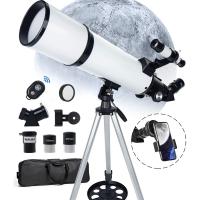
Refractor telescopes use lenses for focusing light, offering sharp and high-contrast images. They are a favorite among astrophotographers for wide-field imaging. Some specialized refractors, called apochromatic refractors (APOs), reduce chromatic aberration (color fringing) and are highly recommended for astrophotography.
Pros: Lightweight, low maintenance, sharp images.
Cons: Smaller aperture compared to reflectors of the same price.
Best Use: Wide-field astrophotography, starfields, large nebulae.
Recommendation: Explore the Sky-Watcher EvoStar 80 ED or the William Optics Zenithstar 61 APO for beginner-friendly refractors.
2. Reflector Telescopes
These telescopes use mirrors to collect and focus light, delivering high image quality with larger apertures for a lower cost. The Newtonian reflector is the most common type. However, the open-tube design requires occasional collimation and camera placement may be awkward for some.
Pros: Affordable, excellent light-gathering capabilities.
Cons: Requires maintenance; chromatic aberration isn’t an issue, but coma may appear at the edges.
Best Use: Capturing planets, galaxies, nebulae.
Recommendation: The Sky-Watcher 6” Dobsonian with an equatorial tracking platform is a budget-friendly reflector option for astrophotography.
3. Catadioptric Telescopes
These hybrid designs combine lenses and mirrors, offering a compact form factor and versatility. The two popular types are Schmidt-Cassegrain Telescopes (SCTs) and Maksutov-Cassegrain Telescopes.
Pros: Compact and portable, good tracking options available.
Cons: Longer focal lengths make wide-field photography difficult.
Best Use: High-magnification photography of the Moon and planets.
Recommendation: The Celestron NexStar 6SE is a versatile choice for those seeking a computerized system for astrophotography.
4. Astrographs
Astrographs are telescopes specifically designed for astrophotography, equipped with flat fields and wide apertures. They are an excellent option if your primary focus is photography rather than visual astronomy.
Pros: Optimized for imaging, fast focal ratios (allow shorter exposure times).
Cons: Expensive and specialized.
Best Use: Serious astrophotography enthusiasts.
Recommendation: Consider a Takahashi Epsilon 130D or the Celestron RASA 8.
Cameras and Accessories for Telescope Mounting
Your choice of camera also plays a massive role in the final image quality. Here are a few pointers:
DSLR and Mirrorless Cameras: These versatile cameras work well with most telescopes, especially if you’re starting out. Brands like Canon and Nikon have wide compatibility with telescope adapters.
Dedicated Astrophotography Cameras: Designed specifically for capturing celestial objects, these cameras often have cooled sensors to reduce noise during long exposures.
Adapters and T-Rings: Match the adapter or T-ring to your specific camera brand for easy attachment.
Field Flatteners and Focal Reducers: These accessories improve image sharpness, especially with refractors and SCTs.
Suggested Setup for Beginners
For newcomers to astrophotography, consider starting with a smaller refractor telescope equipped with an equatorial mount:
Telescope: Sky-Watcher EvoStar 72ED or William Optics Zenithstar 61 APO.
Mount: Sky-Watcher EQ6-R or an iOptron CEM26.
Camera: Any entry-level DSLR or mirrorless camera, paired with the appropriate T-ring and adapter.
Practical Tips for Telescope-Camera Setup
1. Practice Polar Alignment: A well-aligned equatorial mount is crucial for accurate tracking and long-exposure photography.
2. Use a Remote Shutter or Intervalometer: Reduce vibrations and set up multiple exposures efficiently with these tools.
3. Experiment with Exposure Times and ISO Settings: Different celestial objects require different settings. Trial and error will improve your results over time.
4. Invest in Post-Processing Software: Programs like Photoshop or PixInsight are invaluable for editing and stacking astrophotography images.
5. Start Simple: Begin with wide-field shots of constellations or the Moon, and gradually work toward capturing deep-sky objects.
Closing Thoughts
Selecting the right telescope for camera mounting depends on your goals, experience level, and budget. While refractor telesc